Cognitive autonomy
Protecting our capacity to think and decide in an environment governed by algorithms.
Technology, power and the new social contract
Artificial intelligence is redefining work. Platforms influence our decisions. Economic power is concentrating. Humanity 2050 understands these phenomena as parts of the same transformation.
Online purchase · A direct sales link will be added soon
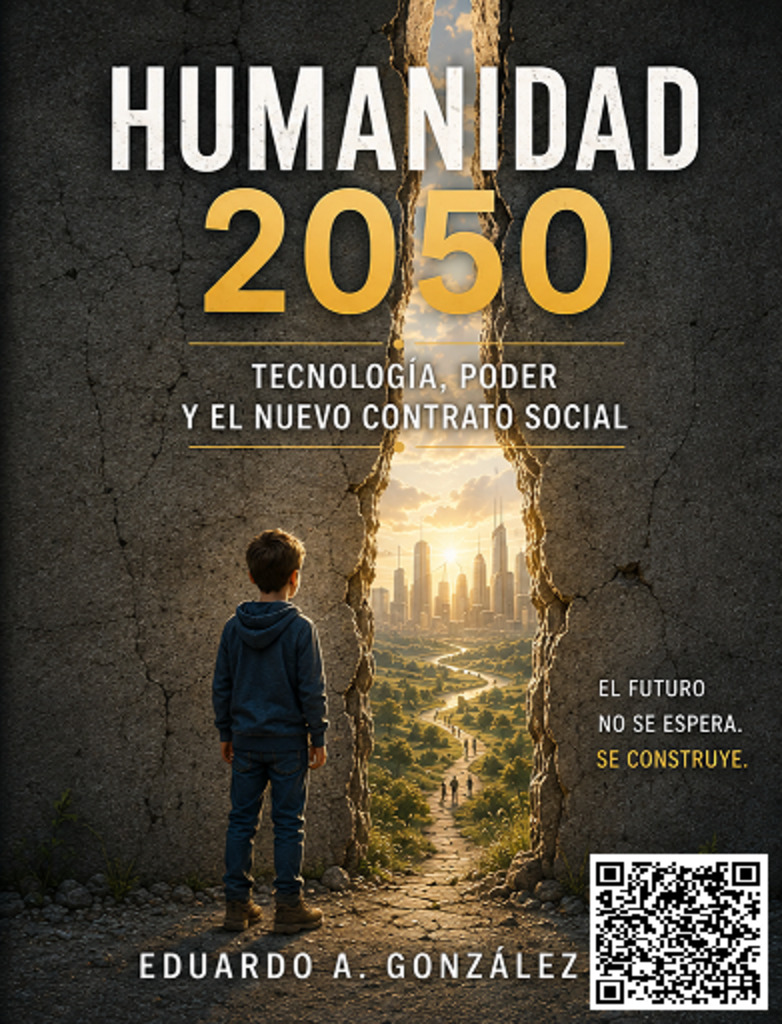
Automation, inequality, democracy, algorithms and the loss of belonging are often discussed separately. This book examines them as expressions of the same historical transformation.
“The challenge is not to adapt without debate to the world ahead, but to decide which world we want to build.”
Coming soon
Artificial intelligence, automation, the environmental crisis and concentrated power are transforming work, democracy and the way we live.
If employment ceases to be the main distributor of income, identity and belonging, how will society hold together? This book proposes a new social contract based on dignity, democratic participation, care and the collective governance of technology.
It offers no magical solutions, but ideas and possible paths to prevent the future from remaining in the hands of a few.Sixteen chapters connect technology, work, democracy, power, autonomy, territory and community as parts of one system.
This is not about predicting 2050. It is about understanding the decisions we must make today.
Protecting our capacity to think and decide in an environment governed by algorithms.
Understanding it as a democratic infrastructure capable of producing cooperation and freedom.
Separating the right to a dignified life from the immediate economic value of employment.
Recovering local capacities without abandoning global cooperation.
Making visible who controls the infrastructures that organize everyday life.
Building a network of intelligence, responsibilities and rights for a different society.
The book’s architecture
The book connects changes that are usually examined separately and reaches the author’s political and personal conclusion: society can govern technology only by rebuilding its collective capacity to think, decide and act.
Global infrastructures increasingly shape the economy, information and everyday life.
Material dependence, captured attention and influence over desires, perceptions and decisions.
Fragmentation diminishes our ability to understand the system and respond collectively.
The place where cooperation, deliberation, care and agency can be rebuilt.
Recover the ability to understand, verify information and decide without invisible conditioning.
Rebuild trust, recognition and shared responses to vulnerability.
Turn community agreements into institutions, resources and effective democratic power.
“Just as the nuclear age built physical shelters against a material threat, the technological age must build social shelters against concentrated power and the manipulation of human behavior.”The intelligent community is the democratic shelter of the technological age. Cognitive autonomy is its first defense.
This is not about hiding from technology. It is about building the collective capacity to understand it, govern it and place it at the service of human life.
Against economic and technological powers operating globally, no person or community can respond alone. Our most concrete defense begins when we recover the capacity to meet, cooperate and decide together.
Recognize the capacities, needs and resources already present in each territory.
Share experiences and solutions without losing local identity or autonomy.
Create networks capable of addressing problems no single community can solve.
Tell us who you are, where you work and which challenge you want to address. This first stage will remain private and may later develop into a network for exchange among communities.

Book presentations, lectures, interviews and public conversations with universities, social organizations, companies, media and educational spaces.
Share a reflection, ask a question or propose an initiative. Your message will remain private and will not be published.
humanidad2050@gmail.comCurrent and upcoming options
The eBook is the only active edition at this time. Print and Amazon options remain visible but disabled until launch.
Pay through Mercado Pago and confirm the operation with your email address. After payment verification, the eBook will be sent to that inbox within 48 hours.
Enter your email and Mercado Pago operation number after payment. Other editions are not yet available.A physical edition for domestic delivery will be enabled once copies and shipping arrangements are available.
This option does not accept payments or reservations yet.Future paperback, hardcover and Kindle editions for international distribution through Amazon.
There is no active Amazon listing yet.Choose an option and complete payment through Mercado Pago, with no preliminary form.
Send the Mercado Pago operation number and the email address where you want to receive the eBook.
After verification, the eBook will be sent to the email address provided within 48 hours.
On a phone, tablet or computer using a compatible app; it may also be sent to selected e-readers when the format allows it. No special device is required. Access will be personal and protected, with a limited number of downloads; exact conditions will be displayed before payment.
For bulk or institutional purchases, contact the author directly.
Some books explain one part of the present.